💪 ACFT Score Calculator
Enter your performance for each event – points update live.
ACFT Calculator — Get Your Army Combat Fitness Test Score Instantly
There’s no guesswork on test day if you’ve already run your numbers. The ACFT Calculator takes your six-event performance data, applies the current Army scoring standards, and returns your complete score breakdown in seconds. Whether you’re eight weeks out from a test date or just finished a training block, knowing exactly where you stand is the first step toward training smarter.
What This Calculator Does and Why It Matters
The Army Combat Fitness Test replaced the legacy APFT in 2022 and brought with it a significantly more complex scoring system. Six events. Age and gender brackets. Three MOS physical demand categories. A per-event minimum alongside a total score minimum. Cross-referencing all of that manually against an ACFT score chart takes time — and leaves plenty of room for error.
This tool handles all of it automatically. Enter your gender, age group, and raw performance number from each event. The calculator references the official 2025 and 2026 Army standards and returns your individual point totals along with your overall score out of 600. Accurate, instant, and free.
The Six Events — What Each One Tests
Understanding the purpose behind each event changes how you train for it. Here’s what the Army is actually measuring:
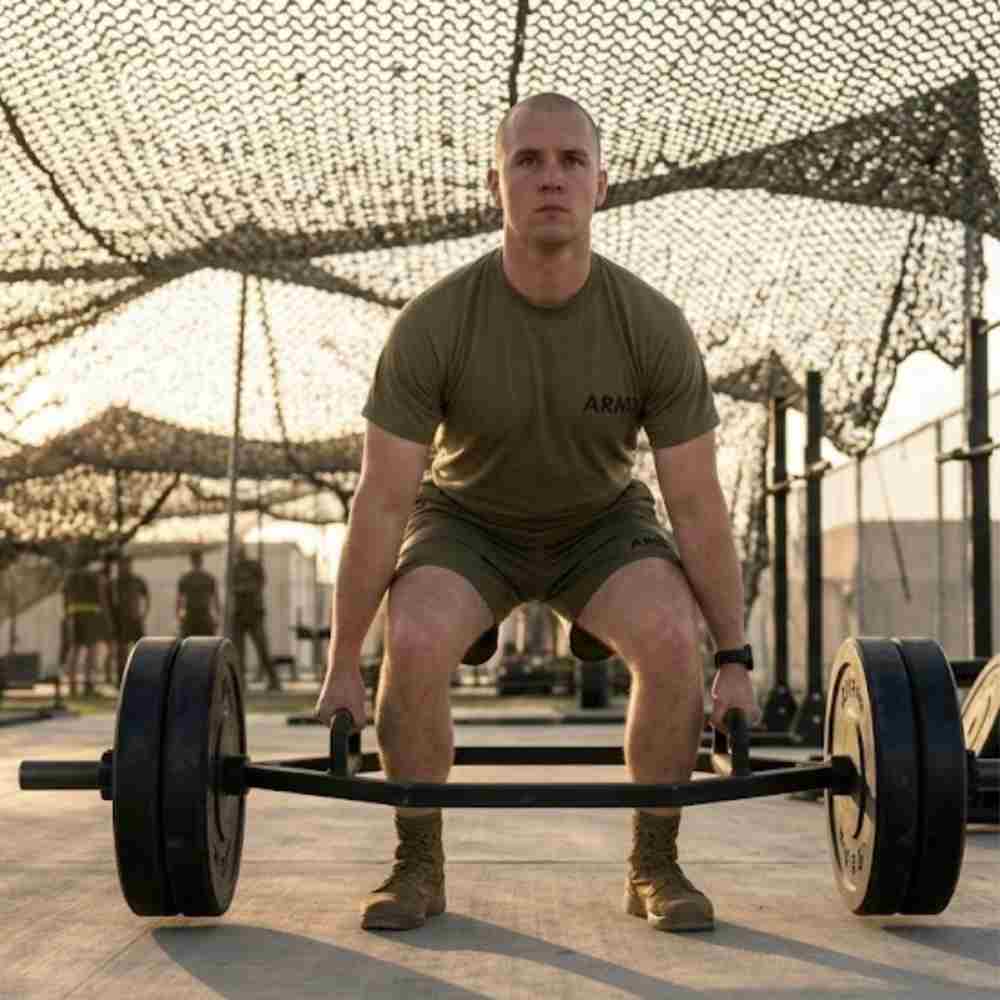
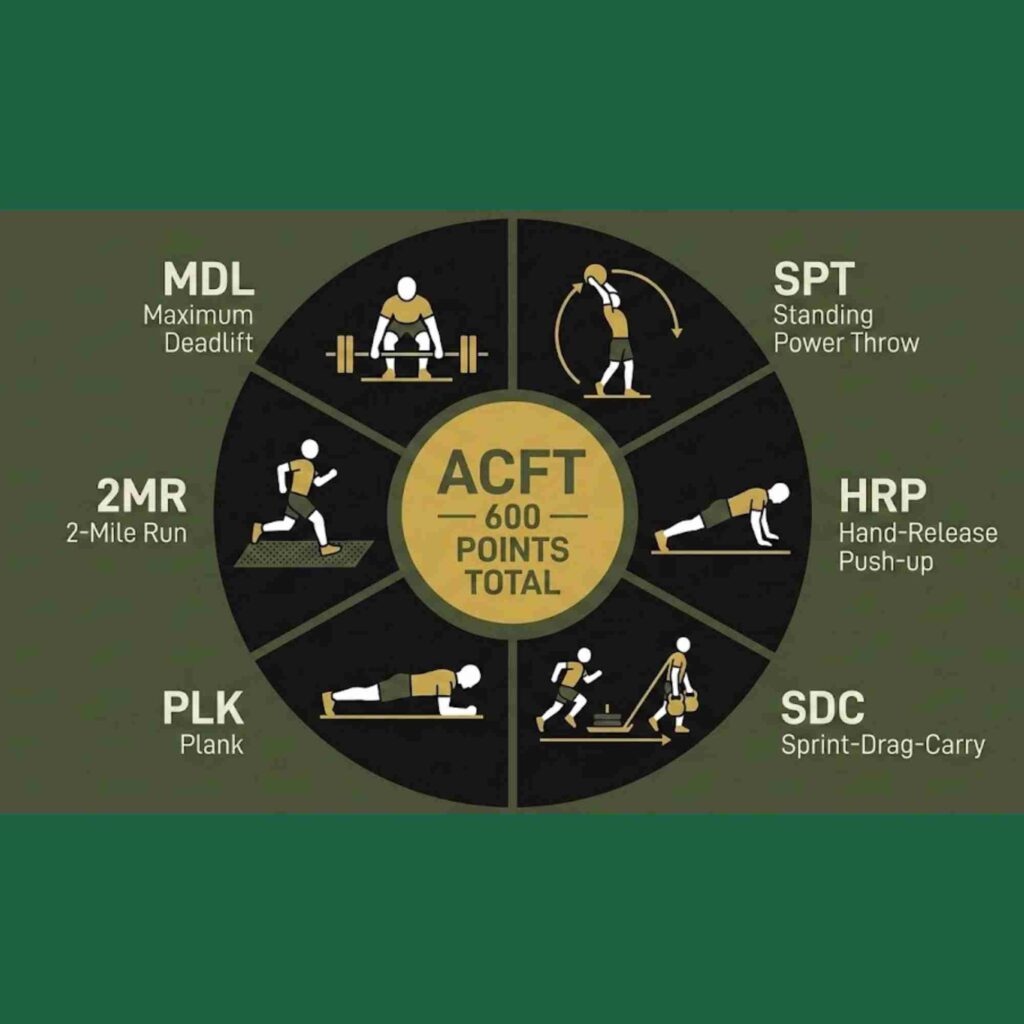
3-Repetition Maximum Deadlift (MDL) — Three reps at your maximum load using a hex bar. This isn’t just a strength test; it reflects functional capacity for tasks like lifting casualties, moving equipment, and loading vehicles under field conditions.
Standing Power Throw (SPT) — A 10-pound medicine ball thrown backward overhead for maximum distance. The goal is explosive power generation, which transfers directly to athletic and tactical movements in combat environments.
Hand-Release Push-Up (HRP) — At the bottom of every repetition, both hands leave the ground. This eliminates the elastic rebound of traditional push-ups and demands genuine upper-body pressing strength. Rep count determines your score.
Sprint-Drag-Carry (SDC) — A 250-meter shuttle combining sprints, sled drags, lateral shuffles, kettlebell carries, and a final sprint. Your completion time is your score. This event hits anaerobic capacity, muscular endurance, and coordination all at once.
Plank (PLK) — Standard forearm plank held for maximum time. The Army moved away from sit-ups to assess real core stabilization rather than hip-flexor endurance. Longer holds earn higher point totals.
Two-Mile Run (2MR) — The aerobic anchor of the test. Your finish time converts directly to points. Aerobic base, pacing, and mental toughness all factor in.
Each event contributes equally to your total, which is why well-rounded training consistently outperforms specialization in a single area.
Scoring Standards by MOS Category
Not every soldier is held to the same minimum. The Army assigns each Military Occupational Specialty to one of three physical demand tiers:
- Heavy (Black): 440 total points minimum, at least 70 points per event
- Significant (Gray): 440 total points minimum, at least 65 points per event
- Moderate (Gold): 360 total points minimum, at least 60 points per event
Knowing your MOS category before you calculate tells you exactly what “passing” means for your career. A score that easily clears the Gold standard may fall short for a Heavy MOS soldier.
ACFT Score, Promotion Points, and Your Military Career
Physical fitness directly feeds your promotion point worksheet. Soldiers can earn up to 180 promotion points from physical fitness scores, depending on branch and component. A score in the 540–600 range typically earns maximum points in this category, while scores between 360–439 earn proportionally fewer.
The practical implication: if you’re close to a promotion board cutoff, identifying your weakest ACFT event and improving it systematically can produce more promotion points per training hour than almost any other preparation strategy.
Run your numbers through the calculator, look at which events have the lowest per-100 efficiency, and build your training block around closing those gaps first.
Alternate Events and 2026 Updates
Some soldiers qualify for alternate event substitutions due to documented medical profiles. If your test includes non-standard events, confirm that the version of the ACFT Calculator you’re using explicitly supports alternate event scoring — not every tool does. Using a standard-only calculator when your test includes substitutions will produce an inaccurate score projection.
For 2026, the Army has indicated continued alignment with the current six-event format. Check for updated scoring tables before your test cycle to ensure your calculator is pulling from the most current official standards.
Frequently Asked Questions
What is the maximum possible score on the ACFT?
The total maximum is 600 points — 100 points from each of the six events. Achieving a perfect or near-perfect score requires top-tier performance across strength, explosive power, muscular endurance, and aerobic capacity simultaneously. Within the Army fitness community, consistently scoring above 540 is recognized as a meaningful benchmark of overall physical readiness.
How often should I use the ACFT Calculator during my training cycle?
Most coaches working with military athletes recommend a formal score check every three to four weeks during an active training block. That frequency is close enough to capture real progress but spaced enough that meaningful changes are measurable. Running a quick check after any peak training week — or within two weeks of a scheduled test date — is also standard practice.
Does the ACFT Calculator account for alternate events?
It depends on the specific tool. Standard calculators are built around the six core events and won’t produce accurate results if one of those events has been substituted. If you’re testing under an alternate event profile due to a medical profile or temporary exemption, verify that the calculator you’re using has that functionality built in before you rely on its output for planning purposes.
How does my ACFT score connect to promotion points?
Your ACFT total feeds into the physical fitness portion of the promotion point worksheet. The higher your score, the more points you earn in that category — up to the branch-specific maximum. For soldiers in competitive promotion cycles, the difference between a 460 and a 520 on the ACFT can represent dozens of promotion points. Consistent tracking and targeted event improvement is the most direct way to move that needle.
Is the ACFT score chart different for men and women?
Yes. The scoring tables are separated by both gender and age group, meaning the number of points awarded for a given performance varies across demographic brackets. The calculator applies the correct table automatically once you enter your gender and age range, so your projected score will reflect the same standard used on an official test.
What should I prioritize if I’m failing one specific event?
Focus on the event where your current score falls furthest below the per-event minimum for your MOS category, not just the one with the lowest raw score. A soldier scoring 58 on the MDL (below the minimum for their category) needs to fix that before worrying about improving a 75 to an 85 on any other event. The calculator makes this gap analysis straightforward — look at which events are pulling your total down and train those with specific, progressive weekly goals.