🌍 Global GST Calculator
Calculate GST for any country – instant, accurate, and free.
📊 Calculation Results
GST Calculator: Calculate Goods and Services Tax Instantly (India, Pakistan & Global)
You see GST on every bill, every invoice, every online purchase. But when you're the one who needs to calculate it—whether you're pricing a product, checking a supplier's invoice, or preparing a return—the math suddenly feels less straightforward.
Do you add 18%? Remove 18%? Multiply by 1.18 or divide by 1.18? Get it wrong and you're either undercharging customers or overpaying the tax authorities. Neither ends well.
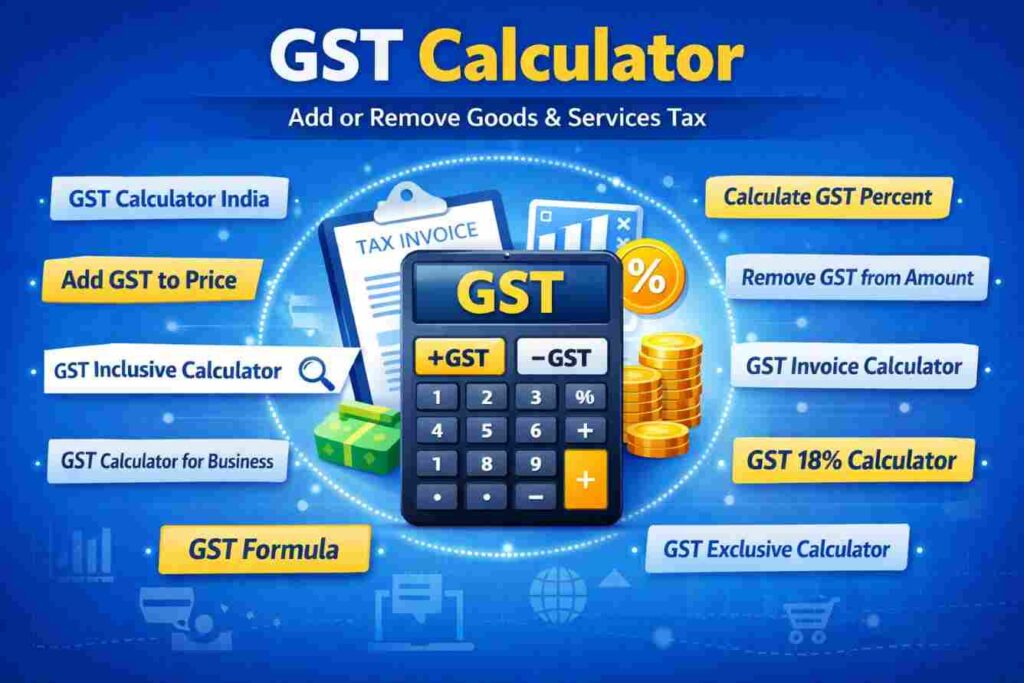
A GST calculator takes the guesswork out of the equation. Enter any amount, choose your rate, and instantly see the tax component and final price. No mental math. No costly mistakes.
What This GST Calculator Actually Does
It solves one problem: giving you accurate numbers in seconds. Whether you're in India dealing with 5%, 12%, 18%, or 28% slabs, or in Pakistan where the standard rate is 17%, this tool handles it all.
You'll see four key values every time:
- Original amount: The price you started with
- GST amount: The tax component itself
- Total including GST: The final price you pay or charge
- Total excluding GST: The price before tax (when working backwards)
Toggle between Add GST (starting from a base price) or Remove GST (starting from a total that already includes tax). The calculator handles the rest. You just read the result.
How GST Works in Different Countries
GST in India: A Four-Slab System
India's Goods and Services Tax, implemented on July 1, 2017, replaced a complex web of central and state taxes with a unified system . The GST Council sets rates based on how essential goods and services are:
- 0% (Nil-rated): Essential items like fresh milk, unpacked cereals, and educational services
- 5%: Mass-consumption goods like roasted coffee, spices, and packaged food items
- 18%: The standard rate for most goods and services, including electronics, furniture, and restaurants
- 40%: Luxury and sin goods like high-end motorcycles, aerated beverages, and yachts
For intra-state sales (within the same state), the tax splits equally into CGST (Central GST) and SGST (State GST) . For inter-state sales, IGST (Integrated GST) applies at the full rate .
GST in Pakistan: A Different Approach
Pakistan also levies a General Sales Tax (GST), but it works differently. The federal government sets a standard rate of approximately 17%, administered by the Federal Board of Revenue (FBR) . Unlike India's unified system, Pakistan's GST isn't fully integrated—provinces can levy their own taxes on services separately, creating a more complex compliance landscape for businesses operating across regions .
Global GST Variations
Many countries have their own versions:
- Australia: 10% GST, with businesses registered for GST adding it to most sales
- Canada: 5% GST (federal) plus provincial sales taxes that vary by province
- Singapore: 9% GST, with a simple add/remove system
- UAE: 5% VAT, introduced in 2018
- New Zealand: 15% GST, with a straightforward calculation [citation:Afirmo]
Who Actually Uses a GST Calculator
Small Business Owners Pricing Products
You buy stock for ₹8,500 excluding GST. You need to know the retail price including 18% GST. The calculator shows you ₹10,030. You also see the ₹1,530 tax you'll owe later.
Freelancers Sending Invoices
You quote a client ₹80,000 for a project. They need the invoice to show GST separately. One click gives you the breakdown: ₹67,796.61 net, ₹12,203.39 GST, ₹80,000 total.
Online Shoppers Checking Prices
You're buying from an e-commerce site showing ₹11,800 for a product. Is that inclusive of 18% GST? Remove the tax and you see the base price is ₹10,000.
Accountants Reviewing Supplier Invoices
A ₹1,20,000 invoice arrives with no GST breakdown. Remove 18% and you see the supplier charged ₹18,305 in tax—confirming their math before you pay.
Manufacturers Calculating Input Tax Credit
You buy raw materials for ₹50,000 plus 18% GST (₹9,000). You sell finished goods for ₹1,00,000 plus 18% GST (₹18,000). The calculator helps you determine your net GST liability: ₹18,000 – ₹9,000 = ₹9,000 payable .
The Two Calculations You'll Use Most
Adding GST to a Base Price
Start with your price before tax. For 18% GST, multiply by 1.18.
Example: A manufacturer sells goods for ₹50,000. Add 18% GST:
- Base price: ₹50,000
- GST @18%: ₹9,000
- Total invoice: ₹59,000
The customer pays ₹59,000. The manufacturer owes ₹9,000 to the tax department (before input credit).
Removing GST from a Total Price
Start with the final price including tax. For 18% GST, divide by 1.18.
Example: A retailer sells a product for ₹11,800 including GST. Remove 18% tax:
- Total price: ₹11,800
- GST amount: ₹1,800
- Base price: ₹10,000
The retailer keeps ₹10,000. The ₹1,800 goes to the government.
Common trap: Don't just subtract 18% from the total. ₹11,800 minus 18% gives ₹9,676—which is wrong by ₹324. Always divide, not subtract .
The Formula Behind the Math
When price is exclusive of GST:
GST Amount = (Original Cost × GST%) ÷ 100
Total Price = Original Cost + GST Amount
When price is inclusive of GST:
GST Amount = Original Cost – [Original Cost × {100 ÷ (100 + GST%)}]
Base Price = Original Cost – GST Amount
Real-World Scenarios the Calculator Handles
Scenario 1: Intra-State Sale in India
A Delhi-based wholesaler sells goods worth ₹2,00,000 to a Delhi retailer. GST rate is 18%.
Since it's an intra-state transaction, the tax splits equally:
Scenario 2: Inter-State Sale in India
The same wholesaler sells to a Mumbai retailer. Now IGST applies at 18%:
Scenario 3: Reverse Calculation for MRP
A product shows MRP of ₹1,180 with 18% GST included. What's the base price?
Base Price = ₹1,180 × 100 ÷ (100 + 18) = ₹1,000
GST Amount = ₹180
Scenario 4: GST in Pakistan
A service provider in Lahore charges PKR 100,000 plus 17% GST:
What Trips People Up Most
The Divide vs Subtract Mistake
We said it above but it's worth repeating. Removing GST is division, not subtraction. A ₹1,180 item with 18% GST removed is ₹1,000, not ₹967.60 .
Input Tax Credit Confusion
You pay GST on purchases (input tax) and collect GST on sales (output tax). Your net liability is output tax minus input tax . The calculator helps you track both.
Intra-State vs Inter-State Errors
Applying CGST/SGST to an inter-state sale is incorrect—you must charge IGST. This mistake leads to compliance issues and penalties .
Wrong Taxable Value
GST is calculated on the transaction value, which includes packing, freight, and commissions, but excludes discounts shown on the invoice .
Ignoring Reverse Charge
Under reverse charge mechanism (RCM), the recipient pays GST directly to the government instead of the supplier. This applies to specific notified goods and services .
Why GST Calculators Beat Manual Math
Speed
Manual calculations take time, especially when dealing with multiple rates and quantities. A calculator gives instant results .
Accuracy
Human error is inevitable when you're doing repeated calculations. Calculators eliminate that risk .
Transparency
See the breakdown between CGST, SGST, and IGST clearly. No hidden numbers .
Compliance
Accurate calculations mean accurate returns. That keeps you on the right side of tax authorities .
Free and Accessible
No downloads, no sign-ups, no payments. Just open and use .
Common GST Rates by Product Category
Questions People Actually Ask About GST
How do I calculate GST on a price?
To add GST, multiply the base price by (1 + GST rate/100). For 18% on ₹1,000: ₹1,000 × 1.18 = ₹1,180. To remove GST from a total, divide by (1 + GST rate/100). For ₹1,180 including 18% GST: ₹1,180 ÷ 1.18 = ₹1,000 .
What's the difference between GST inclusive and exclusive?
GST exclusive means tax is added to the price shown. GST inclusive means the price already includes tax. Invoices must show both for transparency .
How is 18% GST calculated on a total amount?
For an exclusive price, GST = Price × 18 ÷ 100. For an inclusive price, GST = Total – [Total × 100 ÷ (100 + 18)] .
What is the GST on ₹50,000?
It depends on the rate. At 5%: ₹2,500; at 12%: ₹6,000; at 18%: ₹9,000; at 28%: ₹14,000 .
How do I calculate GST in Excel?
Use the formula =A2*B2 where A2 is the base price and B2 is the GST rate (as a percentage). For reverse calculation, use =A2/(1+B2) .
Can I claim back GST I paid on purchases?
Yes, registered businesses can claim Input Tax Credit (ITC) on GST paid for business expenses, subject to conditions .
What's the difference between CGST, SGST, and IGST?
CGST (Central GST) and SGST (State GST) apply to intra-state sales, splitting the tax equally. IGST (Integrated GST) applies to inter-state sales, collected by the central government .
How do I calculate GST under reverse charge?
The calculation is the same as forward charge, but the recipient pays directly. For services worth ₹10,000 at 18% under RCM, the recipient pays ₹1,800 to the government .
Is there a difference between GST in India and Pakistan?
Yes. India has a unified, technology-driven system with multiple slabs (5%, 12%, 18%, 28%) and seamless input credit. Pakistan's system is less integrated, with federal GST on goods and provincial taxes on services creating complexity .
How accurate is this GST calculator?
It uses the official formulas prescribed by tax authorities. For India, it follows CGST/SGST/IGST rules. For Pakistan, it applies the standard 17% rate. Results are accurate for standard transactions .
Try It Yourself
Enter any amount. Pick your rate. Choose Add or Remove GST.
Three numbers appear. Base price, GST amount, total.
That's your answer. No thinking required.
Need VAT instead? Try our accurate VAT Calculator for quick results.